


Wednesday 9 September, 2026
Emir Aboulhosn, CEO and Co-Founder of NetLync, our partner for GSMA Entitlements Service, discusses how operators must be ready to support this pace to remain competitive.
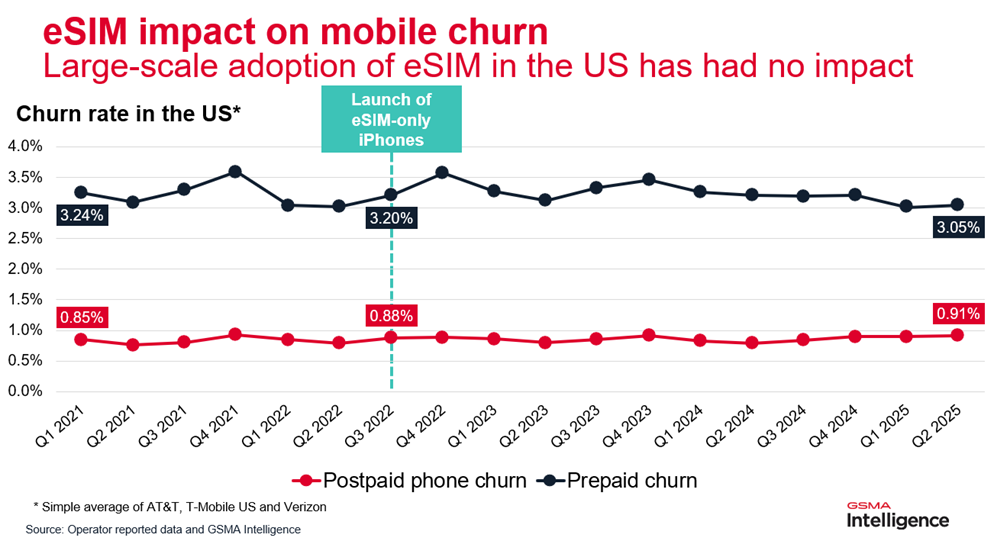
With the launch of Apple’s latest devices, including the iPhone Air, the eSIM-only era has moved from forecast to reality. The removal of the SIM tray signals a decisive shift: connectivity is becoming software-first.
This transition reshapes consumer expectations. Customers now look for instant transfers, remote activation and seamless enablement of services, such as one-click eSIM transfer, satellite messaging and companion devices. Device OEMs are advancing rapidly. Operators must be ready to support this pace to remain competitive.
Adoption and momentum
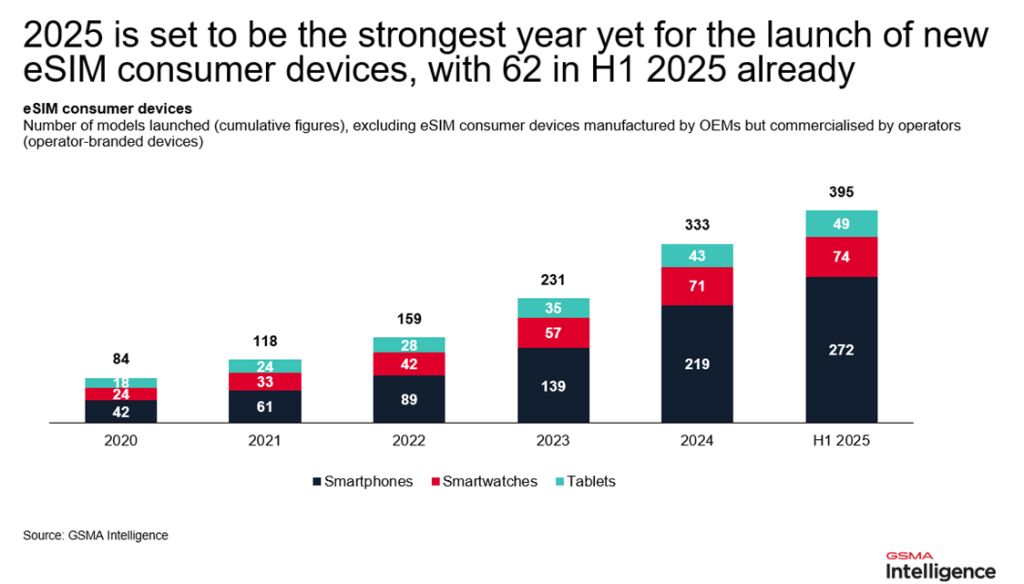
The eSIM ecosystem has reached critical mass. GSMA Intelligence data shows steady growth in both device availability and operator support, with more than two-thirds of operators worldwide offering eSIM connectivity for smartphones. Consumers report greater satisfaction with eSIM compared to traditional SIM cards, especially when upgrading, transferring devices or restoring service.
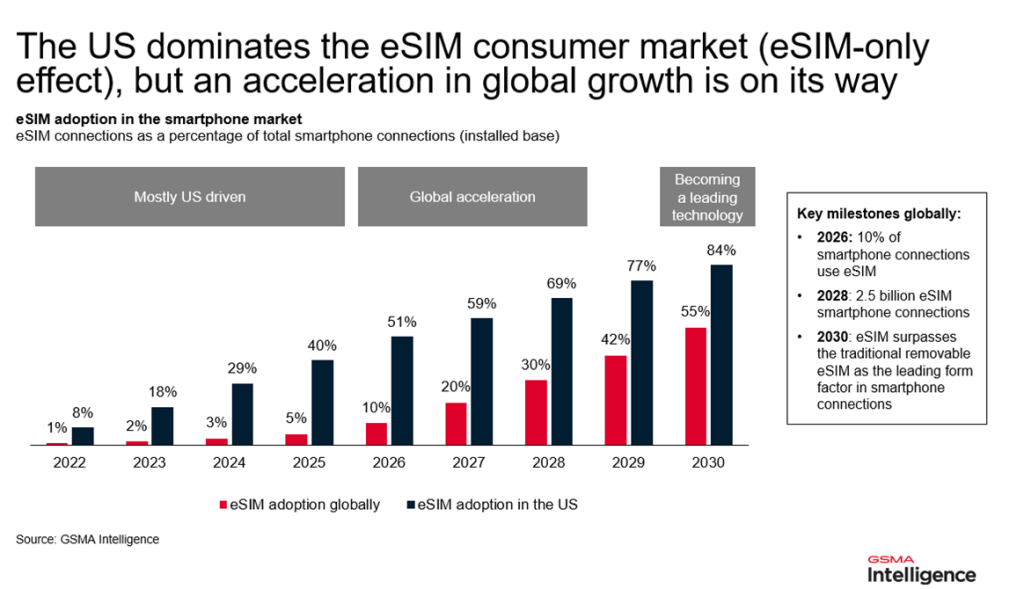
Adoption patterns vary by region. In North America, the introduction of eSIM-only devices has normalised digital activation. In Europe, widespread availability creates competitive pressure to accelerate entitlement deployment. Advanced 5G markets in Asia Pacific are seeing rapid growth in eSIM usage, while Greater China and other regions are expected to expand quickly as ecosystem conditions evolve. In emerging markets, cloud-based entitlement delivery reduces complexity and lowers barriers to entry.
Key Challenges
Despite progress, several challenges remain:
– Legacy infrastructure: Many operators still rely on traditional entitlement systems with longer deployment cycles and more complex integrations, causing new device features to often arrive months late.
– Customer experience gaps: Without entitlements in place, consumers face failed transfers, unavailable services or the need to contact support for help. In an eSIM-first world, these failures are highly visible and directly affect brand perception.
– Rising technical debt: Every year spent maintaining entitlement systems makes migration more complex and costly, reducing the flexibility needed to adapt to new device OEM requirements.
– Competitive pressure: As more operators launch advanced entitlement services, those without equivalent capabilities risk being perceived as outdated, even if their core network performance remains strong.
GSMA Entitlements
To address these challenges, GSMA has launched GSMA Entitlements, delivered in partnership with NetLync. This platform brings entitlement infrastructure into the cloud as a fully managed service, compliant with OEM standards and GSMA specifications.
What makes this partnership unique is the integration of GSMA Network Settings Exchange (NSX) into the platform. This makes GSMA Entitlements not only a delivery system for entitlements, but also a hub for distributing the correct device settings worldwide.
The result is a solution that is:
– Self-serve, with carriers able to onboard within weeks, not months.
– Supported, with GSMA providing guidance to ensure every deployment stays on track.
– Simple, with pay-as-you-grow commercials that remove barriers to entry.
This isn’t incremental improvement. It’s a reset for how carriers approach entitlements.
Industry Impact
Reimagining ‘Entitlements as a Service’ aligns with the GSMA’s vision for its interoperability solutions: to enable a world where every device connects seamlessly to any mobile network —intelligently, instantly and securely. The GSMA is focused on fostering deeper collaboration between operators and OEMs, and its interoperability testing, NSX and now entitlements services, are central to this mission.
For operators, modern entitlement infrastructure shortens time to market for new features, cutting out the endless integration projects, the manual workarounds and the delays that frustrate customers and OEM partners alike. For consumers, it means faster activations, simpler device changes and access to the full capabilities of their devices from day one. For manufacturers, it ensures global consistency in service enablement.
Looking ahead
The transition to eSIM-only devices marks a significant milestone in the evolution of mobile connectivity. Operators that adapt quickly will be positioned to deliver enhanced services and improved customer experiences, while those that delay risk falling behind consumer expectations and device innovation cycles.
GSMA Entitlements provides a pathway to accelerate adoption, reduce integration burdens and ensure consistent, standards-based delivery of next-generation services worldwide.
For further information about GSMA Entitlements, please complete the form below. One of our representatives will be in touch.
