



Wednesday 20 May, 2026
Becoming the foundation layer for digital communication
Featured partner blog by: David Kinser, Director, Product Management, Phone Intelligence, TransUnion and Shamit Bhat, Senior Product Director, GSMA Industry Services
Organisations are increasingly relying on digital channels to reach customers and prospects with outbound communications. Despite the rise of messaging apps like WhatsApp and WeChat, SMS continues to operate at massive global scale. In fact, it remains one of the most widely used features on mobile phones. Today, 65% of the world’s population use text messaging with over 560 billion texts sent every month. It’s no surprise that 53% of consumers say SMS is their preferred form of communication.
Engagement rates other channels can’t match
Business decision makers surveyed for a recent Forrester consulting study listed SMS as their second most used channel for outbound communications after email. On average, the organisations surveyed sent 8 million SMS messages monthly in 2024.
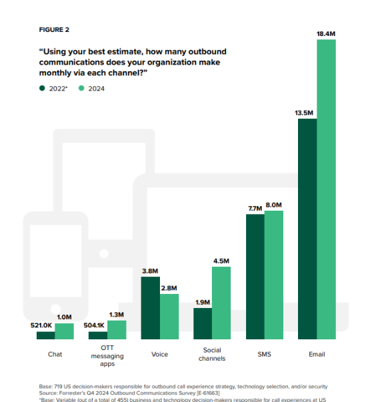
One of the biggest reasons SMS has endured is its extraordinary engagement rate:
- 98% of SMS messages are opened.
- 95% are read within three minutes.
- SMS response rates are 209% higher than phone calls, email or social media. (source)
Compare that to email, which averages an open rate of around 20% and it becomes clear why over 70% of businesses rely on SMS as a way to communicate with customers. From appointment reminders to service alerts, SMS has become an essential tool for customer engagement.
Healthcare providers, for example, have discovered SMS reminders dramatically reduce missed appointments. Fewer than 5% of appointments are cancelled when patients receive text reminders, and some organisations have reduced revenue loss by more than 30% through SMS notification programmes.
The most accessible digital channel
Another reason SMS continues to thrive is its unmatched accessibility. Unlike messaging apps, SMS works on virtually any phone, including basic feature phones, and it doesn’t require Wi-Fi or mobile data. This makes SMS one of the most equitable digital communication tools available, reaching people regardless of geography, income level or device type.
SMS has even been used to improve health outcomes for smoking cessation and maternal health programmes. For public services, including healthcare, education and emergency alerts, this universal reach is critical. SMS can also deliver multilingual and culturally tailored communications to diverse populations, helping bridge digital divides that app-based platforms sometimes widen.
SMS powers the Internet of Things (IoT)
Many people associate texting with person-to-person communication, but SMS has quietly become a key technology behind the Internet of Things (IoT).
Millions of connected devices rely on SMS as a simple and reliable way to trigger actions or exchange information with backend systems. In these scenarios, SMS often functions as a shoulder tap, which is a lightweight message that prompts a device to perform a task.
Examples include:
- connected cars receiving SMS commands for remote locking/unlocking, diagnostics, climate control, find-me features and service alerts.
- smart meters sending readings to energy providers.
- smart home devices delivering alerts about temperature changes or security events.
Automakers, for instance, use SMS to remotely manage embedded SIM profiles in connected vehicles, adhering to GSMA standards for over-the-air (OTA) provisioning. With millions of cars still operating on long lifecycle platforms, SMS will remain essential for maintaining connectivity, even as networks evolve.
AI and automation are giving SMS new life
Far from being obsolete, SMS is now intersecting with some of the most advanced technologies in the digital ecosystem. Artificial intelligence is already enhancing SMS-based services through AI chatbots handling customer support via text, or predictive text and smart replies that speed up conversations.
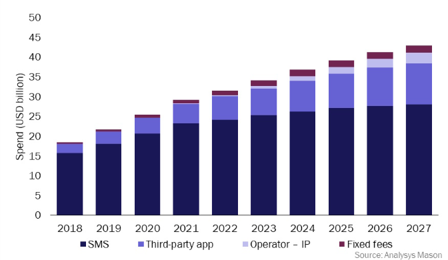
According to GrandView Research, the global Application-to-Person (A2P) messaging market is projected to reach approximately $125.8 billion by 2033. A2P SMS offers the greatest messaging revenue opportunity for mobile operators (see chart below) and it’s one of the most engaging. These systems can deliver highly personalised interactions while preserving the simplicity that makes SMS so effective.
Mordor Intelligence highlights that another key trend in the A2P SMS industry is the rising demand for secure authentication. Banks, e-commerce platforms and digital service providers use SMS to send one-time passwords (OTPs) and verification messages. SMS authentication remains popular because it is easy to use and works on all types of mobile phones.
Simple on the surface, powerful behind the scenes
SMS has survived multiple waves of technological disruption. From smartphones to messaging apps, it continues to evolve among emerging technologies like AI, connected devices and digital health platforms. Its secret is simple: universality.
SMS works on nearly every mobile device, requires minimal infrastructure and delivers unmatched engagement. As new technologies grow more complex, that simplicity becomes even more valuable.
Rather than disappearing, SMS is increasingly becoming the foundation layer for digital communication, a reliable, accessible channel that supports everything from customer engagement to connected vehicles and AI-driven services.
Accurate A2P routing with GSMA Pathfinder™
SMS continues to underpin critical A2P use cases such as authentication and notifications. This is where knowing the terminating end point is essential for a B2C business, so each SMS reaches the desired customer through their current network.
GSMA Pathfinder™ is a number portability discovery service built on GSMA NG.105 PRD. The solution supports the SMS ecosystem by improving visibility into terminating end points. This helps A2P businesses reduce costs on misdirected SMS traffic and most importantly enables the right message to reach the right phone number at the right time.
This enhanced visibility into SMS routing supports responsible traffic management, improved interconnect trust and a more resilient A2P messaging environment. This in turn has helped support trusted A2P messaging growth and enable service providers to make informed data-driven decisions across global SMS routes.
About GSMA PathFinder™
GSMA PathFinder™ is an authoritative, real‑time number resolution service that helps ensure SMS messages are accurately routed worldwide. Operated by TransUnion on behalf of the GSMA since 2008, PathFinder provides trusted operator identification for 8.6 billion phone numbers across more than 240 countries and territories—giving mobile operators, social media companies and aggregators access to the critical information they need to deliver communications securely and reliably.
Designed to improve cost efficiency and customer experience, PathFinder leverages daily and real-time updates from 100+ authoritative data sources to reflect continuous number portability changes and maintain exceptional accuracy. With 99.999% platform availability, four redundant query sites and a cloud-based solution with linear scaling, organisations can quickly access up‑to‑date routing and porting information to support global SMS delivery and A2P messaging.
To learn more about GSMA Pathfinder™, visit https://www.gsmaservices.com/network-services/gsma-pathfinder/ or www.transunion.com/solution/trucontact/numbering-services/gsma-pathfinder
