


By Shamit Bhat, Senior Product Director, GSMA, in collaboration with Emir Aboulhosn, Founder and CEO, NetLync.
Juniper Research forecasts operator revenue from Rich Communication Services (RCS) Business Messaging to reach $2 billion in 2026, growing to $6.5 billion by 2030. Business RCS traffic is expected to exceed 200 billion messages annually by 2027, while active RCS users are projected to surpass 3.8 billion globally by the end of 2026.
In this blog, operators can discover how to unlock the full potential of RCS Business Messaging (RBM) for your network and your subscribers.
The vision of native messaging
For more than 15 years, Rich Communication Services (RCS) has been the GSMA’s vision for the future of native messaging — an open, interoperable standard designed to succeed SMS and deliver richer, more engaging mobile communications.
For years, that vision advanced primarily through Android while the wider mobile ecosystem gradually evolved. With Apple’s adoption of RCS in 2024, one of the industry’s longest-standing fragmentation challenges has finally being addressed. Rich messaging is no longer confined to a single operating system — it is becoming a truly cross-platform experience across both Android and iOS.
This marks a significant milestone for the mobile industry and creates an even greater commercial opportunity for mobile operators. However, while network capability is now largely in place, the remaining challenge is ensuring eligible devices are automatically enabled for RCS services.
The commercial opportunity behind cross-platform RCS
RCS Business Messaging is rapidly evolving from an alternative communications channel into the future of enterprise messaging.
Brands increasingly want to engage customers through verified, interactive conversations delivered directly within the native messaging application. Rich cards, suggested replies, carousels, high-quality images and verified sender identities create experiences that are significantly more engaging than traditional SMS.
As mentioned in the introduction, the market is responding accordingly, while the addressable market is equally compelling. According to GSMA Intelligence, approximately 6 billion devices worldwide are already RCS-capable, including around 4.5 billion Android devices and more than 500 million Apple devices running iOS 18 or later.
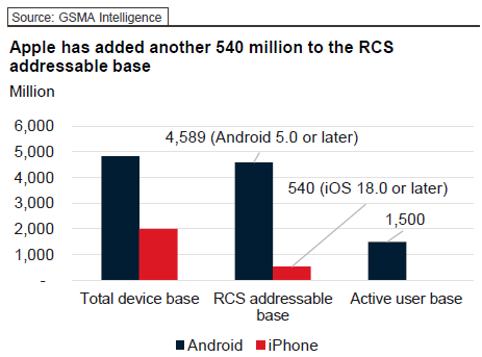
For operators, the opportunity has never been greater. However, brands expect universal reach. Delivering premium messaging experiences across only part of a subscriber base limits both adoption and the commercial potential of RCS Business Messaging.
Network capability alone isn’t enough
Consider a subscriber using an RCS-capable iPhone messaging an RCS-capable Android device. On paper, that conversation should automatically benefit from rich messaging features. In reality, it often doesn’t. If the subscriber’s account has not been verified and provisioned by the operator for cross-platform RCS, the conversation can still fall back to legacy SMS or MMS despite both devices being fully capable.
The issue is no longer network capability, but service activation. Without intelligent device enablement, operators risk fragmented customer experiences, inconsistent service activation and missed revenue opportunities for RCS Business Messaging.
Turning network capability into activated services
This is where GSMA Entitlements provides the missing link. When a subscriber activates a compatible device, the GSMA Entitlement Server automatically verifies whether the subscriber is eligible for RCS services and securely provisions the required capabilities at the operating system level.
The process is seamless, standards-based and requires no manual configuration from the subscriber. By automatically enabling cross-platform RCS across Android and iOS, operators can eliminate unnecessary fallback to SMS and MMS while ensuring subscribers immediately benefit from a rich native messaging experience.
The result is faster service activation, reduced operational complexity and a consistent experience across multiple operating systems and device manufacturers.
Delivering value for subscribers and operators
For subscribers, the experience is exactly what modern messaging should be. Conversations flow seamlessly between Android and iPhone users without requiring over-the-top messaging applications. Features such as typing indicators, read receipts, high-quality media sharing and enhanced group messaging become available natively, creating a richer and more consistent user experience. RCS is an operator-native standard which can be used globally without the regulatory bans or access restrictions that frequently block popular OTT messaging apps in various regions.
For operators, the benefits extend far beyond customer satisfaction. A fully activated RCS subscriber base creates a larger addressable audience for RCS Business Messaging, enabling operators to unlock new enterprise revenue opportunities while strengthening customer engagement.
Verified sender identities also help combat phishing and SMS fraud, reinforcing trust in operator-provided messaging services and positioning operators as secure custodians of enterprise communications. Rather than losing engagement entirely to third-party messaging platforms, operators remain at the centre of the mobile messaging ecosystem.
Unlocking the full potential of RCS
Apple’s adoption of RCS has brought the industry closer than ever to the GSMA’s original vision of universal, standards-based messaging.
However, supporting the RCS protocol is only the first step. To fully realise the commercial opportunity, operators must ensure every eligible subscriber can access RCS services automatically from the moment they activate their device.
By combining standards-based entitlement with intelligent device enablement, GSMA Entitlements helps operators accelerate adoption, simplify deployment and unlock the full commercial potential of cross-platform RCS.
To learn more about GSMA Entitlements and seamless cross-platform RCS activation, complete the short form below.
This article was developed in collaboration with NetLync, a GSMA Industry Services partner supporting entitlement solutions for mobile operators globally.